
How to Buy Your First Rental Property
What if the biggest obstacle to building wealth through real estate isn’t finding the perfect property, but overcoming your own mindset?
Many new investors struggle with their initial purchase. Some get stuck analyzing every detail and never take action. Others rush into deals without understanding the financials. Both approaches can lead to missed opportunities or financial losses.
Successful real estate investors follow a proven system. This removes much of the guesswork from the acquisition process. A profitable rental can deliver monthly cash flow, long-term appreciation, and valuable tax benefits.
This guide draws from real-world investor experiences. You’ll learn practical strategies you can implement immediately. We’ll also cover the time commitment and financial requirements involved.
Building a solid foundation now will set you up for success in your real estate journey. Let’s explore the systematic way to approach this exciting investment opportunity.
Key Takeaways
- Many new investors struggle with analysis paralysis or rushing into bad deals
- Successful real estate investing follows a proven, systematic process
- Rental properties offer monthly cash flow, appreciation potential, and tax advantages
- Proper due diligence is essential before making any purchase
- Real estate requires active involvement and realistic expectations
- Learning from experienced investors can accelerate your success
- Building a strong foundation now leads to long-term wealth creation
Introduction to Rental Property Investing

Many investors are drawn to rental properties for their unique combination of income generation and wealth building. This investment approach offers three primary financial benefits that work together to create strong returns over time.
Understanding the benefits of cash flow, appreciation, and tax advantages
The first advantage is monthly cash flow – the income remaining after all expenses are paid. This provides regular passive income that can supplement your earnings.
Property appreciation represents long-term growth potential. Historical data shows markets like Seattle averaging over 6% annual appreciation. However, view this as a bonus rather than your primary strategy.
Tax advantages significantly enhance your return. You can deduct mortgage interest, property taxes, repairs, and depreciation. These deductions offset your taxable income from the property.
Identifying the challenges and responsibilities of being a landlord
Even with professional management, you remain responsible for major decisions. Emergency repairs, tenant issues, and unexpected vacancies require your attention.
Consider your readiness for this commitment. Do you have 6-12 months of mortgage payments saved? Can you handle middle-of-the-night emergency calls?
Following proven principles leads to success. Focus on properties that generate positive cash flow from day one. This approach builds wealth while managing risks effectively.
How to Buy Your First Rental Property

Financial preparation and psychological readiness form the foundation of any successful rental property strategy. Taking time for honest self-assessment prevents costly mistakes.
Assessing your financial readiness and risk tolerance
Beyond the down payment, you need reserves for closing costs and unexpected repairs. Calculate your comfort level with leverage and vacancy risks.
| Risk Level | Leverage Comfort | Vacancy Tolerance | Repair Fund |
|---|---|---|---|
| Low | Minimal debt | 1 month max | 6+ months reserves |
| Medium | Moderate financing | 2-3 months | 3-6 months reserves |
| High | Aggressive leverage | 4+ months | 1-3 months reserves |
Recognizing the investment fundamentals through real-world examples
One real estate professional identified rentals as the right investment in 2008 but waited until 2010 to purchase. Despite industry experience, they needed time to save capital and overcome psychological barriers.
Many agents discouraged this investor, calling rentals “money pits.” These opinions often came from people who lost properties during the crisis or invested poorly.
The successful approach involves securing good deals, ensuring positive cash flow, and maintaining long-term perspective. This investor eventually refinanced their home to access $50,000 for their first acquisition.
Following proven fundamentals dramatically increases success chances, even when the path requires patience.
Financing Your Investment Property

Navigating the mortgage process for an investment requires different preparation than a home loan. Lenders view these properties as higher risk. This leads to stricter requirements you must understand.
Exploring financing options and down payment requirements
Be prepared for a larger initial payment. You typically need 20-25% of the purchase price. For a $200,000 property, that means saving $40,000 to $50,000.
Conventional loans are the most common path. They are sold to agencies like Fannie Mae. These loans have strict rules about property condition and your credit.
Portfolio lenders, often local banks, keep loans in-house. They offer more flexibility. They might approve a property needing repairs or accept a lower credit score.
Private money lenders provide speed. They can close in 1-2 weeks. The trade-off is higher interest rates, often between 8% and 12%.
Understanding credit scores, pre-approval, and reserve funds
A credit score of 720 or above will secure the best interest rates. You can still qualify with a lower score, but your costs will be higher.
Getting pre-approved is a crucial first step. Sellers of good deals prefer buyers with confirmed financing. This puts you in a strong position to act quickly.
Lenders will scrutinize your finances. They require tax returns, bank statements, and proof of income. Some may ask you to explain large deposits.
One investor learned this the hard way. Their lender required explanations for every deposit over $1,000 for a full year. This caused multiple closing delays.
They were also convinced to put 25% down for a slightly lower rate. In hindsight, they regretted tying up that extra cash. It could have been used for another investment.
Always have reserve funds. Lenders often require 2-6 months of mortgage payments in the bank. This protects you from unexpected vacancies or repairs.
Evaluating Rental Property Metrics for ROI
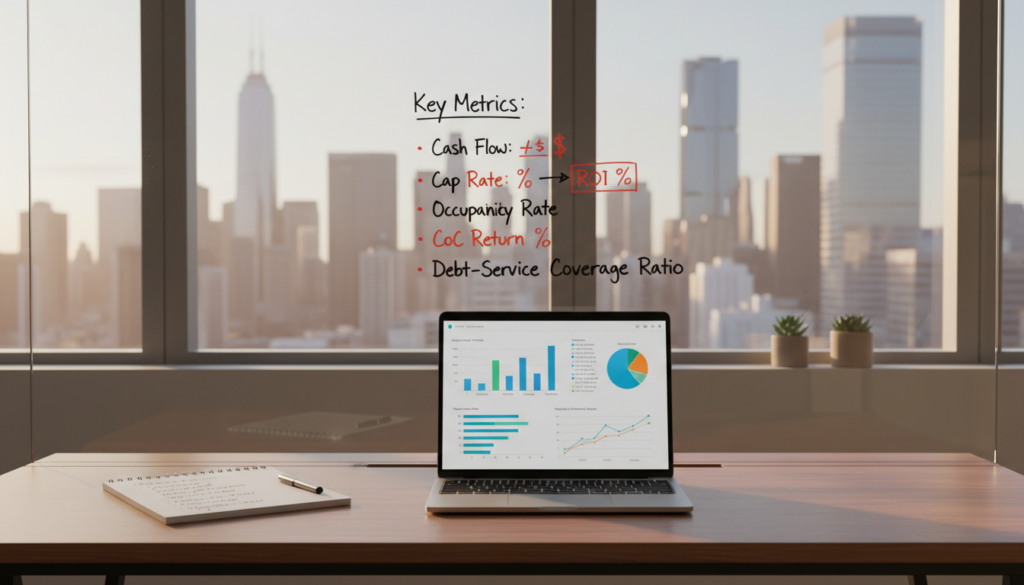
Understanding key financial metrics separates successful investors from hopeful buyers. Mastering a few essential calculations helps you evaluate potential returns accurately.
Calculating cash flow, cap rate, and gross rent multiplier
Start with cash-on-cash return. First, estimate total annual rental income, including fees for pets or parking. Then calculate operating expenses, typically 40-50% of gross rent.
Consider a $250,000 property with $50,000 down. Annual rental income of $24,000 minus $9,600 in expenses and $11,000 mortgage interest leaves $3,400 annual cash flow. That’s a 6.8% cash-on-cash return.
Cap rate measures performance independent of financing. Gross rent multiplier serves as a quick screening tool. Lower multipliers often indicate better potential return.
Leveraging spreadsheets and investor tools for analysis
Free online tools simplify these calculations. They automatically compute cash flow, net operating income, and cap rate when you input basic property data.
One investor purchased their first investment for $96,900. Over nine years, they generated $64,800 in cash flow plus significant tax benefits and equity growth.
Analyze at least 20 similar properties before making offers. This builds pattern recognition for typical rent ranges and repair costs. You’ll quickly identify genuinely good deals versus average investment opportunities.
Proper financial analysis protects your capital. It ensures each property purchase moves you closer to long-term wealth building.
Selecting the Optimal Market and Property Type
Location decisions create the foundation for your entire investment journey. The choice between local and remote investing depends on your personal situation and market conditions.
Local versus remote investing considerations
Local investing works best when your area offers cash-flow positive properties. You can easily visit for inspections and understand neighborhood dynamics.
Remote investing becomes attractive in high-cost markets. Someone in San Francisco might find better returns in Kansas City or Atlanta. This approach allows diversification across multiple real estate markets.
| Investment Type | Best For | Key Advantages | Potential Challenges |
|---|---|---|---|
| Local | Hands-on investors | Familiarity with area | Limited market options |
| Remote | Diversification seekers | Better cash flow opportunities | Property management complexity |
Evaluating neighborhood dynamics and property features
Look for markets with strong job growth and diverse employment sectors. These properties tend to be more resilient during economic changes.
Many investors prefer single-family homes for their familiarity and availability. Tenants often treat these property types as their permanent home, providing better care.
Desirable features include walkability to amenities and three-bedroom layouts. The extra room serves as a home office, appealing to today’s remote workers. Properties with basement apartments offer additional rental income potential.
Conducting Due Diligence and Closing the Deal
Once your purchase offer receives approval, a critical window opens for comprehensive property verification. This limited timeframe requires systematic checking of all assumptions made during evaluation.
Performing property inspections and reviewing financial documents
Professional inspections examine structural, electrical, and mechanical systems. They help identify hidden defects that could lead to expensive repairs.
Estimate repair costs for any issues discovered. Budget an additional 10-20% cushion for unexpected problems. This protects your investment from surprise expenses.
Verifying legal aspects, insurance, and lender requirements
Confirm property insurance availability and cost. Check the title report for liens or easements. These legal details affect your ownership rights.
Review settlement statements carefully for unexpected fees. Lock your mortgage rate if not already secured. This prevents rate increases during the closing process.
Findings during this phase may require renegotiating the purchase price. Major issues could significantly alter your expected returns. Be prepared to walk away if problems outweigh benefits.
Effective Rental Property Management and Tenant Selection
Choosing the right management approach can make or break your rental property’s profitability and your peace of mind. The decisions you make here directly impact your cash flow and stress levels.
Deciding between self-management and hiring a property manager
Self-management works best when your property is nearby and you have time for tenant calls. This hands-on approach saves the 8-12% management fee, maximizing your monthly income.
Hiring a professional property manager makes sense for distant properties or when you lack time. Companies like Mynd handle tenant screening, rent collection, and maintenance coordination across many markets.
Implementing tenant screening and retention strategies
The search for quality tenants starts with thorough screening. Check credit scores, employment history, and background reports. Even with a management company, meeting applicants in person provides valuable insights.
Being a responsive landlord prevents tenant turnover. Address repair requests promptly and communicate clearly about rights and responsibilities. Regular property visits and professional cleanings help maintain your investment while showing tenants you care.
This proactive management process ensures stable rental income and protects your property’s long-term value. Good tenant relationships reduce vacancies and maintenance costs over time.
Conclusion
One investor’s nine-year experience with their initial acquisition demonstrates the remarkable potential of strategic property ownership. Their first rental generated $119,400 from a $25,000 investment, excluding appreciation.
The property appreciated from $96,900 to $275,000. Their only regret was not purchasing more rentals sooner. They learned that paying off mortgages too quickly limited growth potential.
Successful real estate investing follows core principles. Focus on properties with positive cash flow from day one. Secure deals below market value and maintain long-term perspective.
Use leverage wisely rather than rushing to eliminate debt. The $70,000 used for early payoff could have purchased additional properties generating higher returns.
Every seasoned investor started with their first purchase. Apply these proven fundamentals to begin building wealth through rental properties confidently.
FAQ
How much money do I need to buy my first rental property?
What is a good rate of return on a rental property?
Should I manage the property myself or hire a property manager?
How do higher interest rates affect my investment?
What are the biggest tax advantages of owning rental real estate?
How important is my credit score when getting a loan?
What is the 1% rule in rental property investing?

Eduard Kingly is a travel and lifestyle content creator with a focus on personal development and education. He combines firsthand travel experiences with research-driven insights to guide readers in discovering new places, building better habits, and pursuing meaningful learning.